Our Philosophy
Most people sense when a space isn’t working before they can say why — the kitchen everyone avoids, the office that looks right and thinks wrong. We’ve spent years learning to name it, and to fix it before money gets spent in the wrong direction.
Belief one
Most design starts with what’s current — what photographs well, what the magazines are showing. We start with who lives and works in the space, and what they need it to do for them.
A bedroom that’s dark and quiet enough to actually sleep in. A kitchen the whole household can cook in at once. Morning light where you drink your coffee. A workspace you can focus in during the loudest hour of the day. None of that comes from a trend board. It comes from paying attention — to routines, friction points, what restores people and what drains them.
The aesthetics follow, and they land better, because they’re anchored to something real. A space that fits its people doesn’t go out of style.
Trend-designers ask “what should this look like?” We ask “who lives here — and what do they need this space to do?”
Belief two
Most projects go sideways before a single nail is driven. Not because the vision was wrong, but because it was never fully formed. People move forward on assumptions. Decisions get made under pressure. And by the time the problems show up, they’re expensive to fix.
So we put the work where the risk is: before the commitment. Discovery before design. Design before drawings. Drawings — real ones, rendered so you can see the finished result — before anyone signs a construction contract. Every decision gets made looking at the actual outcome instead of imagining it.
When you can see the outcome before you commit to it, the whole project changes.
Belief three
The best outcomes don’t come from one person’s vision handed down to everyone else. For a home, that means the whole family gets a voice — not just the person making the decisions. For a business, it means the people on the floor, not only the leadership team. Everyone who moves through a space every day knows something about what’s working and what isn’t. We listen to all of it.
And it doesn’t stop at the front door. Projects involve partners, builders, architects, sometimes investors — and most stalled projects stall on people: the couple seeing two different rooms in the same drawing, the owner and contractor talking past each other. We’ve learned one rule the hard way, and it’s now absolute: the decision-makers are in the room, or productive design doesn’t happen.
Plenty of studios make renderings. The renders are the medium. Alignment is the product.
Belief four
Most designers treat the budget like an awkward subject — something to bring up late, after you’ve fallen in love with a concept you can’t afford. We think that’s backwards.
The budget isn’t a limit on the design. It’s part of the design — as real as the square footage. Knowing it early doesn’t make the design smaller; it makes it better, because every choice gets made against what’s actually possible.
So we talk numbers from the first session. Every concept comes with realistic ranges, drawn from years of estimating and building real residential projects. You will never be shown something we know you can’t build.
A design you can’t afford to build isn’t a design. It’s a picture.
Belief five
People change. Families grow. Work moves home. A hobby becomes a business. Kids leave, and a bedroom needs a new job. A space that fit one chapter of your life might need to grow into the next — and that’s not a failure of design. It’s what living spaces do.
Most of our clients come back not because something went wrong, but because life moved on. So we design for the chapter you’re in, with the next one in mind — and we keep the 3D model of your space, so the next change starts from where we left off instead of from scratch.
The work is never fully done — and that’s exactly how it’s supposed to be.
Design for the photo
If a choice makes the room better in pictures and worse to live in, we don’t make it.
Start without alignment
Design work doesn’t begin until the actual decision-makers are in the room and pointed the same direction. We learned that one the hard way.
Chase trends
If it’s wrong for your space and your life, it doesn’t matter how popular it is this year.
Pretend about money
We won’t present a design we know you can’t afford to build. Realistic numbers come with every concept, from the first conversation.
You'll feel these beliefs in how we listen, how we look at a space, and how we make decisions. They shape every conversation we have — from the first call to the final walkthrough.
And one honest thing: we practice all of this at home. Two people with different instincts, designing one house that has to work for both of us — and it’s still a work in progress. That’s not a confession. It’s the point.
Most project deliverables end up in a drawer. A folder on a hard drive. A PDF nobody opens after the first meeting. They communicate the plan but don’t sustain the commitment to execute it.
We think differently about what a deliverable should do. The best ones don’t just document a vision — they hold it. Something accurate enough to build from and beautiful enough to hang on the wall. Something a client looks at every morning and remembers why they started.
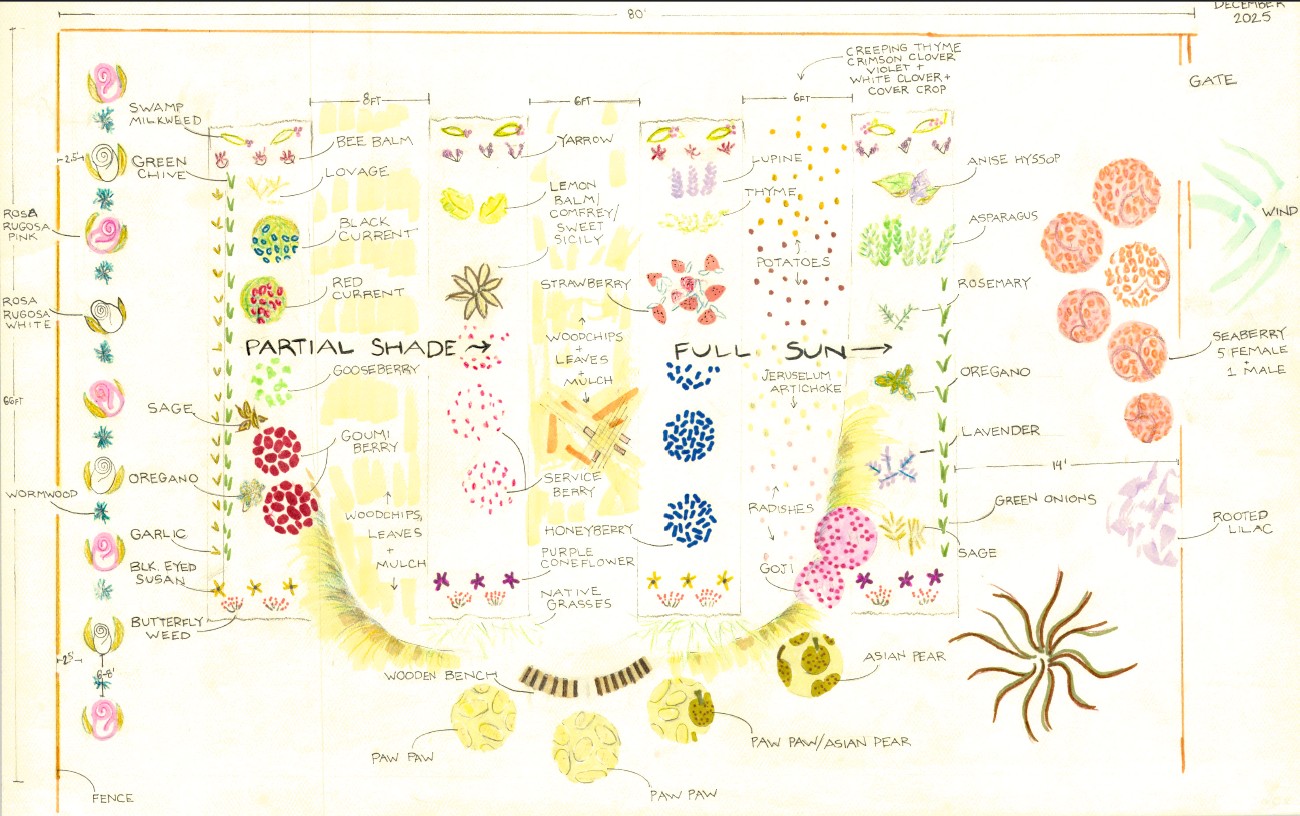
Britten’s hand-drawn landscape plans are built to do exactly that. Precise enough to guide a contractor. Personal enough to frame. Clients put them up before the first shovel breaks ground — and leave them up long after.
“When you can see it, you can decide. When you can decide, the project moves.”
Food forest landscape plan — hand drawn by Britten Tracy, December 2025.
Book a free 20-minute call. No pressure, no commitment. Just a conversation about your project, your space, and whether we're the right fit.